It seems as if there has been a concerted effort over the last number of years to write systematic theologies that were accessible to the general public within the church without watering down the theology itself. This attempt to make theology accessible is needed now more than ever. As biblical Christianity is pressured from multiple sides to abdicate its positions on issues from life to sexuality to Israel, the ability to understand what all of scripture teaches about a given subject is only going to get more important.
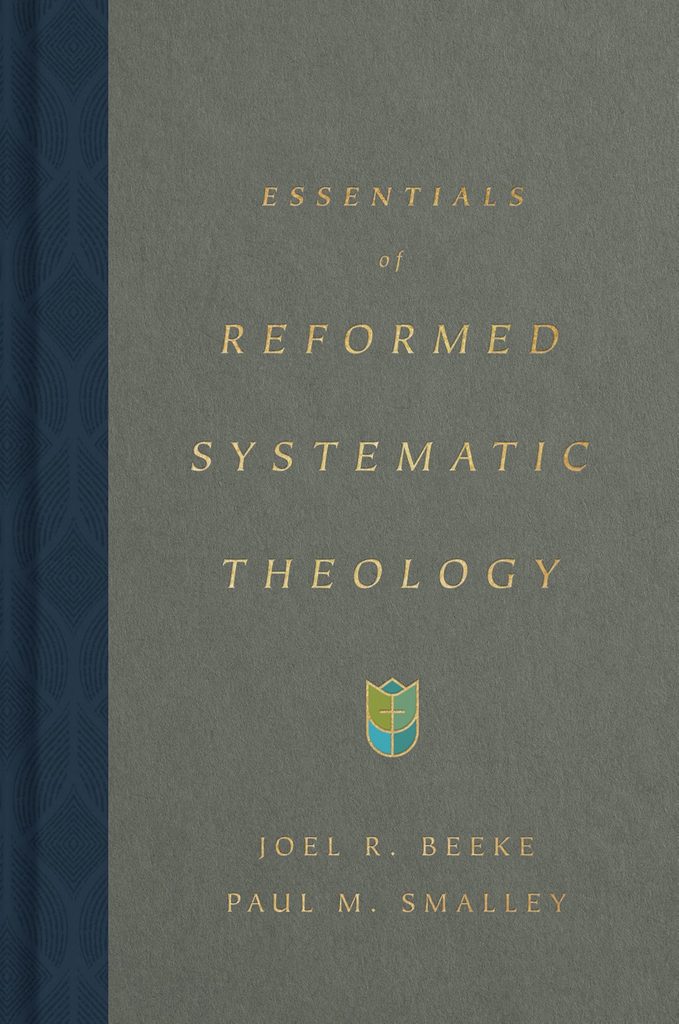
Joel Beeke is no stranger to the world of conservative evangelical theology. His work at Puritan Reformed Theological Seminary is well known. He has written pretty extensively in the world of theology and has a passion for pastors. He has also attempted to write an accessible systematic theology for the local church. In Essentials of Reformed Systematic Theology, Beeke seeks to give Christians a one-volume systematic that covers the essentials of theology. He largely succeeds in the task.
“Systematic theology answers the question, what does the whole Bible teach about each of its major topics and its relation to other topics?” (6). “It is the grand story of God, creation, the fall of man, redemption accomplished, redemption applied, a new people formed, and the restoration of all things” (9). This is important to understand. Believers need to see how they fit into the great story that God is telling through history and redemption. In a world that has largely lost its sense of purpose, systematic theology gives mankind a jolt equivalent to a favorite energy drink. It puts all of life into a framework that helps make sense of it all.
Beeke breaks his work into seven large sections, beginning with the doctrine of the knowledge of God. This section focuses on divine revelation and includes both general and special. This section lays a solid foundation for the book, especially when the author deals with “Errors regarding Special Revelation” (46-50). This section brings the clear claims of scripture into stark contrast with the claims of Roman Catholicism and other belief systems. It helps the reader understand why a clear theology of scripture is so important.
Part two deals with the Doctrine of God. Here Beeke walks through the nature and attributes of God, addressing outside believe systems that fall short with defective views of deity. This section is very helpful to readers who need to understand their God better. It is a deep knowledge of God that will guide Christians through the deepest valleys of life. The author emphasizes the sovereignty of God. He takes a traditional reformed approach to the will of God, emphasizing a “preceptive” and “decretive” will (the first being what “should” happen, and the second being what “will” happen). This section also contains Beeke’s argument for a reformed perspective on election. “The crown jewel of the doctrine of God’s sovereignty is his election of those whom he would save by grace” (188). I fall on the same side of this issue as Beeke, so I will leave it to the reader to evaluate if he makes his case well or not. One thing I noted is that in a treatment whose goal is to be succinct, a reader almost needs to go to other sources for deeper arguments on controversial issues. The page count of Beeke’s book simply does not allow for exhaustive treatments of any one subject.
Part three deals with anthropology. The book takes a biblical stance on the creation of man and on gender and sexuality. Beeke will rub some on the progressive side of Christianity with his (biblical) position that “there is no such thing as a gay or lesbian Christian any more than there is a Christian adulterer or a Christian drunkard” (268). This section is also where Beeke’s covenantal theology comes into play. This plays a major role in the book and needs to be noted. As a progressive dispensationalist, I am going to take some issues with Beeke’s exegesis but will leave it to the readers to evaluate his arguments.
Part four addresses Christology, and while it is a very strong part of the book, I believe the author mischaracterizes dispensational theology relating to Israel in the church, which is a common caricature that fails to deal with the actual issues that differentiate dispensationalism and covenant theology. Beeke does a very nice job though of dealing with the person and work of Christ, which bridges the gap nicely into part five and the doctrines of pneumatology and soteriology. The author defends a cessationist position on spiritual gifts and rejects the position of some charismatics that there is a different type of prophecy today that does not have to be held to the biblical standard of always coming to pass. Beeke walks through a very helpful discussion of the ordo salutis, with strong emphasis on repentance and spiritual growth.
Part six deals with the church. The book makes arguments for both pedobaptism and believer’s baptism. The arguments for baptizing infants are probably some of the weakest sections of the book. Beeke also states that he believes that churches that have representations of Jesus (I would assume that this includes children’s Sunday School materials) are breaking the second commandment.
The final section addresses eschatology. Beeke is anti-dispensational, so this section was the toughest to read. On one hand, he completely rejects the idea that God will keep His promises to Israel in the Old Testament but then argues from Romans 11 that there will one day be a massive spiritual awakening among the Israelites. That being said, Beeke is clear on the second coming of Christ and the reality of eternal punishment in hell.
Overall, Beeke has written a very solid introductory-level systematic theology. It’s probably at the same level as Charles Ryrie’s Basic Theology, but with a covenant theology bent. As long as the reader knows that theological background he is stepping into, I highly recommend Beeke’s work as a nice addition to the world of systematic
theologies.
I received a free copy of this book in exchange for an honest review.