In October of 2013, Al Mohler, president of The Southern Baptist Theological Seminary, was invited to speak at Brigham Young University. His speech was well accepted (he was invited to return at a future date), but he didn’t waffle on theology. At one point he made the statement,
“I am not here because I believe we are going to heaven together. I do not believe that. I believe that salvation comes only to those who believe and trust only in Christ and in his substitutionary atonement for salvation. I believe in justification by faith alone, in Christ alone. I love and respect you as friends, and as friends we would speak only what we believe to be true, especially on matters of eternal significance. We inhabit separate and irreconcilable theological worlds, made clear with respect to the doctrine of the Trinity. And yet here I am, and gladly so. We will speak to one another of what we most sincerely believe to be true, precisely because we love and respect one another. I do not believe that we are going to heaven together, but I do believe we may go to jail together.”
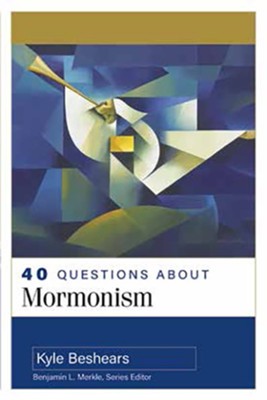
What is it about Mormonism that would indicate that we will not be in heaven together? In the latest in the Kregel “40 Questions” series, Kyle Beshears tackles 40 Questions About Mormonism. He breaks the questions into five categories, and each category offers very solid and fair insight into the theology, history, and practice of Mormonism.
In the first section, Beshears takes a few questions to look at how Christians have studied Mormonism throughout history. These chapters set the stage for the rest of the book and prepare the reader for the approach that the author will take.
Section two delves into the Story of Mormonism. This is where the reader who is new to studying Mormon theology will find much help. The author gives a history of Joseph Smith and the founding of the Mormon religion. He unpacks “the continental divide separating Mormonism from traditional Christianity”- the First Vision (68). It is this vision that drives Smith to establish all that will come after. Beshears also traces the geographical development of the religion, showing how Mormonism became a truly worldwide religion.
Section three address the sources of authority in Mormonism. This is where Mormons begin to create significant distance between themselves and Christianity. The Bible is “foundational as an authority and necessary as a source of revelation, but it was not final. It needed to be reinforced by more revelation” (97). The author refers to this as a difference of opinion over the sufficiency of scripture. I would disagree. I believe this reflects a fundamental difference in how we view the inspiration and authority of scripture. Regardless, the Christian argues for scripture as their ultimate authority, while Mormonism turns elsewhere. The “elsewhere” for Mormons is found in several documents. Beshears addresses the Book of Mormon, The Doctrine and Covenants, The Pearl of Great Price, and The Book of Abraham. Each of these documents carry weight within the Mormon church. 40 Questions then unpacks the Mormon doctrine of the “Priesthood,” which also carries authority in the church.
In Section four, Beshears moves on to address the beliefs of Mormonism. This section is extremely valuable because it carefully unpacks differences in doctrine between Mormonism and Christian theology. One of the strong points of the book is the author’s ability to show how different words are used by both religions, but with different meanings attached to them. This makes a huge difference in the practice theology of the respective faiths.
The final section of the book deals with how Christians should approach Mormonism. This is a good close to the work as it encourages believers to use care in how they address Mormons and Mormonism.
Overall, this addition to the 40 Questions family is a strong one. Beshears relies heavily on primary sources, which gives the reader a lot of opportunity for follow-up. He is careful to deal Mormonism in a fair way, addressing theological differences accurately without relying on extreme rhetoric. He clearly has a heart for seeing these people who dwell in darkness come into the light, and that desire comes through in his writing. I would heartily recommend this book for anyone who is seeking to understand Mormonism better.
I received a free copy of this book from the publisher in exchange for a fair and honest review.