“Worldview” has become a buzzword in Christian circles over the last decade or so. Worldview camps have sprung up, replacing the traditional week at camp for church teens that involved blobs, big balls, and zip lines, with a week of lectures and exercises designed to help believing teens see the world through a biblical lens.
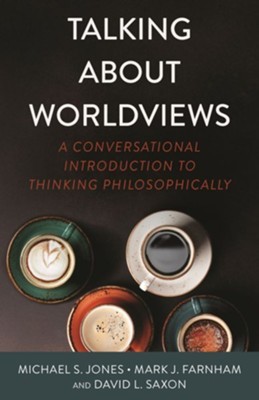
Much of the emphasis within the Christian world on worldview has been a response to a real problem: professing evangelical Christians are consistently demonstrating a way of looking at the world that is secular in nature. There is a need for the church to reclaim the high ground in the battle for worldview. Talking About Worldviews: A Conversational Introduction to Thinking Philosophically is authors Michael Jones, Mark Farnham, and David Saxon’s entry into the discussion.
Worldviews follows much the same pattern as the authors’ previous book, Talking About Ethics. The book contains a story in which characters discuss the topics addressed in each chapter, followed by a more technical portion that unpacks the concepts contained in that chapter. At 598 pages, the book is not a fast read and is written at a college level. It is designed to serve as a textbook for an introductory class on philosophy at the undergraduate level. The authors spend time unpacking how worldviews and philosophy relate to each other. This section is helpful in that it lays the groundwork for the rest of the book.
The next sections deal with Logic, Epistemology, and Metaphysics. Each chapter builds on the previous one in the sense that understanding how logic works is invaluable for beginning to wrestle through the challenges of developing a belief system. Throughout, the authors attempt to present a number of different philosophical positions accurately, which is helpful to the reader as he navigates the strengths and weaknesses of each position.
The second half of the book deals with how philosophy informs discussions on Religion, Ethics, Jurisprudence, and Philosophical Anthropology. These chapters become more practical, as principles of philosophy are applied to significant issues that different societies face.
Worldviews is well-written, and the issues discussed are important. The narrative portion is helpful, though at times it seems a little contrived. I also got lost a few times in the discussions surrounding a few different philosophical issues. Overall, the book gives a thorough introduction to issues of worldview and philosophy, while using story to show the practical applications of the different positions. I heartily recommend this work to anyone looking for a deeper understanding of worldview and philosophy.
I received a free copy of this book in exchange for a fair and honest review.